HÀ NỘI — Vietnam welcomed a record 10.6 million international visitors in the first five months of 2026, up nearly 15 per cent from a year earlier and the highest figure ever recorded for the January–May period, according to data released by the National Statistics Office on Wednesday.
The country received an estimated 1.78 million foreign arrivals in May alone, representing an increase of nearly 17 per cent compared with the same month last year.
Air travel remained the dominant gateway for international visitors, accounting for 8.7 million arrivals, or 82.3 per cent of the total, up 11 per cent year-on-year. Arrivals by road reached 1.7 million, up 40.8 per cent, while sea arrivals rose 15.4 per cent to more than 202,000 visitors.
The strong growth in visitor numbers contributed to rising tourism-related revenues. Revenue from accommodation and food services was estimated at VNĐ400.4 trillion (US$15.2 billion) in the first five months of 2026, up 13.3 per cent from the same period in 2025 and accounting for 12.6 per cent of total retail sales and consumer service revenue.
Several localities posted robust growth in accommodation and food service revenue, including An Giang Province, up 24.4 per cent; Ninh Bình Province, 19.2 per cent; Đà Nẵng City, 18.9 per cent; Huế City, 18.6 per cent; and Quảng Ninh Province, 18.5 per cent.
The country’s two largest tourism hubs, HCM City and Hà Nội, recorded more modest increases of 10.3 per cent and 9.2 per cent, respectively.

Travel service revenue during the January–May period was estimated at VNĐ40.6 trillion, up 12.2 per cent year-on-year. Notable growth was recorded in the south-central province of Khánh Hòa Province, up 33.8 per cent; Quảng Ninh, 25.4 per cent; Quảng Ngãi, 23.3 per cent; Huế, 18.7 per cent; and Hải Phòng, 15.6 per cent.

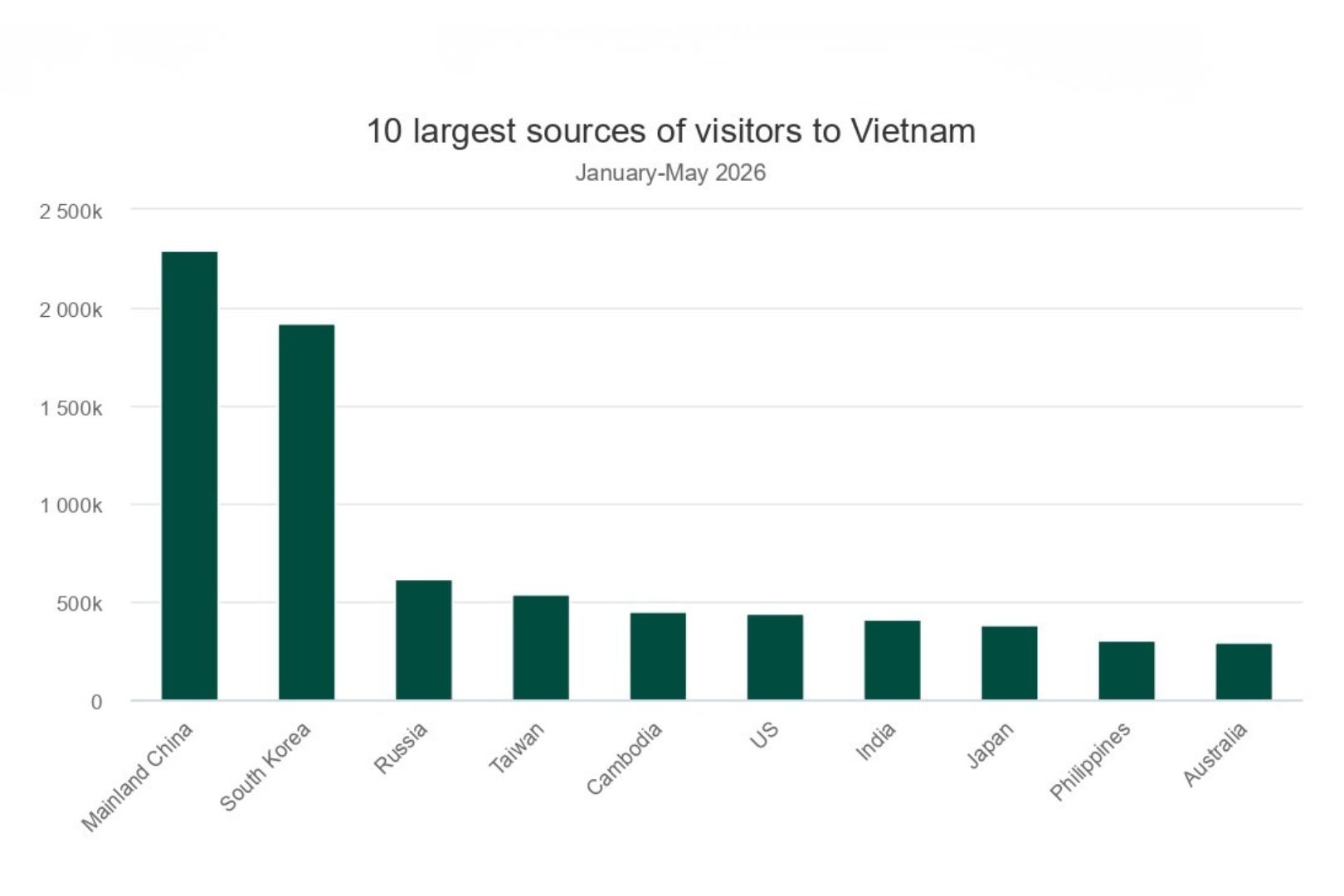
Russia emerged as Vietnam’s fastest-growing source market, with visitor arrivals soaring 194 per cent from a year earlier. The Philippines ranked second, posting growth of 71 per cent.
Notably, the Philippines entered Vietnam’s top 10 source markets for a second consecutive month in April and May, reflecting deepening tourism links between the two Southeast Asian nations.
Vietnam’s tourism authorities have attributed the trend partly to expanded direct air connectivity and similarities in tourism resources and travel preferences between the two countries.
During Party General Secretary Tô Lâm’s state visit to the Philippines on June 1, the two countries signed a Vietnam–Philippines Tourism Cooperation Programme for the 2026–29 period.
The agreement is expected to strengthen destination connectivity, increase tourist exchanges and expand cooperation in tourism management, promotion and sustainable tourism development.
In general, other markets in Southeast Asia also maintained strong growth in the five months, including Cambodia (up 40.2 per cent), Indonesia (28.7 per cent), Singapore (28.5 per cent) and Malaysia (21.0 per cent), while Thailand posted a more modest increase of 8.5 per cent.
In South Asia, India continued to register robust growth of 50.4 per cent, highlighting the market’s significant untapped potential.
The figures underscore Southeast Asia’s growing role as one of the key engines of Vietnam’s tourism growth, supported by geographical proximity, strong air connectivity and the increasing popularity of short-haul intra-regional trave
Despite growing geopolitical uncertainties and economic headwinds in some markets, the Vietnam National Authority of Tourism said the country continues to benefit from its reputation as a safe destination with political stability, social order, and effective risk management.
Tourism officials also cited Vietnam’s diverse attractions, rich cultural heritage, competitive travel costs and expanded visa policies as key factors supporting continued growth.
However, if counting May alone, some major source markets recorded declines. Visitor numbers from China, South Korea, Cambodia, Russia and the Philippines fell between 2 and 10 per cent compared with previous periods, while arrivals from the United States and Australia dropped by 28 per cent and 36 per cent, respectively.
Industry executives said the slowdown was not unexpected, noting that Vietnam’s peak international tourism season typically runs from October to April, while the summer months are dominated by domestic travel demand.
At the same time, many countries in Europe and across Asia are entering their own summer peak seasons, increasing competition for international travellers.
Having achieved around 42 per cent of its annual target in the first five months, Vietnam’s tourism sector is maintaining strong growth momentum, creating favourable conditions to work towards its goal of welcoming 25 million international visitors in 2026 and contributing to the country’s objective of achieving double-digit economic growth, according to the National Authority of Tourism.